

Dubai Chiller Trucks provides certified refrigerated van rental in Dubai and across the UAE. Every booking includes a licensed cold chain driver, an active mechanical refrigeration unit maintaining your required temperature throughout transit, GPS fleet tracking, continuous temperature logging from pre-cooling to delivery acceptance, and complete regulatory documentation — as one accountable service with all-inclusive transparent pricing and no hidden charges of any kind.
The term refrigerated van carries a specific operational meaning in the UAE cold chain industry. A refrigerated van is not an insulated vehicle. It is not a van fitted with a basic cooling box. It is a commercially registered cargo vehicle equipped with a certified, active refrigeration system that continuously removes heat from the cargo compartment throughout transit — maintaining a precise, pre-set temperature regardless of how hot it is outside, how long the journey takes, or how many delivery stops are on the route.

In Dubai’s climate — where ambient temperatures exceed 47°C for months at a time — this distinction between a genuinely refrigerated van and a vehicle that merely resembles one is the difference between cargo that arrives within regulatory specification and cargo that arrives compromised. Dubai Chiller Trucks operates only genuinely certified refrigerated vans, and our operations are built to prove it on every trip through documented temperature data that covers the complete delivery from loading to receipt.
The phrase refrigerated van is among the most misused terms in Dubai’s commercial transport sector. It appears in listings and advertisements applied to vehicles that range from genuinely certified, active-refrigeration commercial vans to basic cargo vans with a portable cooling box placed inside the cargo area. Understanding precisely what a certified refrigerated van is — and why the distinction matters for your cargo and your regulatory compliance — is the starting point for making an informed cold chain transport decision in the UAE.
A certified refrigerated van in the professional cold chain sense is a vehicle that meets all of the following criteria simultaneously. It carries a valid UAE RTA commercial vehicle licence for refrigerated transport operations. Its cargo compartment is constructed with insulation panels meeting commercial cold chain specifications — sufficient thermal resistance to support the refrigeration unit’s performance against Dubai’s ambient heat load. It is fitted with a certified, active mechanical refrigeration unit — a Thermo King or Carrier system, or equivalent brand-certified unit — that actively removes heat from the cargo compartment throughout the delivery. That refrigeration unit has a current calibration certificate confirming its temperature accuracy. The vehicle carries temperature monitoring equipment that continuously records cargo compartment temperature throughout every trip. And the driver operating it holds a UAE commercial vehicle licence and has received specific cold chain handling training.
A vehicle that meets all of these criteria is a certified refrigerated van. A vehicle that fails any one of them is not — regardless of how it is described in a listing, an advertisement, or an informal phone conversation with an uncertified operator.
Dubai Chiller Trucks refrigerated vans meet all of these criteria as a standard operational baseline. Every vehicle, every driver, every booking. Not as a premium option. Not as an upgrade available at additional cost. As the minimum standard we operate to — because it is the minimum standard that Dubai Municipality’s Food Safety Department, ESMA standard UAE.S GSO 2055-1, and professional cold chain practice in the UAE require.
Dubai’s commercial transport market is large, competitive, and — in the refrigerated van segment — highly variable in quality. The combination of significant demand from Dubai’s food service, pharmaceutical, FMCG, and hospitality sectors with relatively low barriers to entry for informal operators has produced a market in which certified, compliant refrigerated van providers compete for bookings alongside operators who use the same terminology to describe vehicles and services that fall significantly below the standards that professional cold chain operations require.
For businesses making refrigerated van rental decisions on the basis of daily rate alone, this market structure creates genuine operational and regulatory risk. The financial consequences of cold chain failure in Dubai extend well beyond the cost of the cargo that is damaged. Dubai Municipality Food Safety Department fines for non-compliant cold transport of regulated food categories. ESMA compliance breach findings. Pharmaceutical GDP protocol failure penalties under client contracts. Retail buyer cold chain audit failures that cost supermarket supply agreements. Reputational damage to food businesses whose product reaches consumers in compromised condition. These are the downstream costs of a refrigerated van booking decision made without verifying the provider’s actual compliance credentials.
The questions a professional cold chain manager asks before booking a refrigerated van in Dubai are specific and verifiable. Is the refrigeration unit a certified brand — Thermo King, Carrier, or equivalent — with current calibration documentation? Is the vehicle commercially registered under UAE RTA for refrigerated transport? Does the driver hold a UAE commercial vehicle licence and cold chain handling certification? Is pre-cooling to target temperature performed before loading? Is temperature monitored continuously throughout transit — not just at departure and arrival? Can a formatted temperature report be provided with the delivery note?
Dubai Chiller Trucks answers yes to every one of these questions, and provides the documentation to prove it on every booking. For businesses who have experienced cold chain failures with previous providers — or who are building a new cold chain logistics function in Dubai and want to establish the right standard from the start — these questions and answers are the foundation of a professional provider selection process.
The chiller configuration maintains cargo compartment temperature between 0°C and +8°C. This range covers the broad category of fresh, chilled goods that must be maintained cold but not frozen fresh produce, dairy products, chilled beverages, fresh meat and fish, bakery and confectionery goods, fresh flowers, pharmaceutical products requiring chilled storage, and cosmetics with temperature-sensitive formulations.
The 0°C to +8°C range is the most widely regulated temperature band in the UAE food safety framework. ESMA standard UAE.S GSO 2055-1 specifies maximum transport temperatures for specific chilled food categories within this range. Dubai Municipality’s Food Safety Department applies compliance monitoring to refrigerated transport vehicles operating in this range. And the pharmaceutical GDP framework for chilled medicinal products defines continuous compliance within this band as a condition of distribution licence validity.
Within the chiller range, specific cargo categories have narrower optimal temperature windows. Pharmaceutical products typically require +2°C to +8°C rather than the full 0°C to +8°C range. Fresh fish has an optimal transport temperature closer to 0°C than the upper end of the chiller band. Certain tropical produce items are sensitive to temperatures below +4°C and perform best in the mid-to-upper chiller range. When cargo has specific temperature requirements within the chiller band, Dubai Chiller Trucks sets and verifies the refrigeration unit at the appropriate target — not simply at any point within the 0°C to +8°C range that happens to satisfy the broadest regulatory definition.
The freezer configuration maintains cargo compartment temperature between -18°C and -22°C. This range is the international standard for frozen food storage and transport adopted in the UAE under the ESMA standard UAE. S GSO 2055-1 and applied by Dubai Municipality’s Food Safety Department to all commercial frozen cargo transport within the Dubai emirate.
Frozen cargo transport in Dubai is among the most technically demanding cold chain categories precisely because the temperature differential between the cargo compartment target and Dubai’s summer ambient environment can exceed 65°C to 70°C. This differential places refrigeration equipment under a sustained thermal load that demands correctly specified, correctly maintained, and correctly operated deep-freeze units, such as the Thermo King and Carrier systems that Dubai Chiller Trucks uses exclusively in our freezer-configuration refrigerated vans.
The choice between chiller and freezer configuration is determined entirely by the cargo’s storage temperature specification. If a product’s manufacturer, regulatory authority, or receiving party specifies that it must be stored and transported frozen at or below -18°C, then a freezer-configuration refrigerated van is required. Not a chiller van at its coldest setting. Not an insulated container with dry ice inside a chiller van. A certified freezer-configuration refrigerated van with an active deep-freeze refrigeration unit and verified compartment temperature.
The UAE’s pharmaceutical distribution sector operates under some of the most demanding cold chain compliance requirements of any industry in the region. Vaccines, biologics, insulin products, oncology medications, temperature-sensitive oral medications, and a growing category of biosimilar and specialty pharmaceutical products all require continuous, documented temperature compliance during distribution — from pharmaceutical warehouse to hospital, clinic, pharmacy, or patient-facing healthcare facility.
For pharmaceutical cold chain distribution at the van level — serving clinic rounds, pharmacy replenishment routes, hospital supply deliveries, and healthcare facility logistics — a certified refrigerated van operating under GDP-compliant protocols is the minimum viable vehicle. Dubai Chiller Trucks refrigerated vans serving pharmaceutical clients operate under documented GDP protocols, with chain-of-custody documentation, continuous temperature logs formatted for UAE Ministry of Health regulatory submission, and drivers who carry current cold chain handling certifications specific to pharmaceutical cargo.
The consequences of pharmaceutical cold chain failure in Dubai extend beyond product loss. UAE Ministry of Health and the Emirates Health Service both regulate pharmaceutical distribution compliance — and a documented temperature excursion on a pharmaceutical delivery can constitute a reportable event under the UAE’s pharmaceutical regulatory framework. Dubai Chiller Trucks temperature documentation is designed to eliminate these events — and to provide the documentary proof that they have not occurred on every delivery we complete.
Dubai’s premium food retail sector — including international supermarkets, specialty organic grocery stores, premium delicatessens, and direct-to-consumer fresh food delivery operations — operates cold chain standards that in many cases exceed the minimum regulatory requirements set by Dubai Municipality. These retailers apply their own supplier cold chain audit standards, require temperature documentation as a condition of delivery acceptance, and in some cases conduct their own unannounced checks on the cold chain integrity of incoming deliveries.
Dubai Chiller Trucks refrigerated vans serving premium food retail clients provide the level of temperature documentation — pre-cooling verification, continuous in-transit data, delivery acceptance temperature — that satisfies both regulatory compliance requirements and the elevated supplier cold chain standards of premium retailers. Our temperature reports are formatted for direct integration into retailer cold chain management systems without manual reformatting from our clients’ logistics teams.
Dubai’s catering sector — from large-scale corporate catering operations and airline galley suppliers to boutique cloud kitchens delivering premium meals across the emirate — relies on refrigerated van transport for both the raw ingredient supply chain and the finished product distribution chain. These are two distinct cold chain applications with different compliance requirements, different temperature specifications for the cargo involved, and different documentation standards expected by the receiving parties.
For ingredient supply, the refrigerated van operates as part of a HACCP-documented food preparation supply chain — carrying raw produce, dairy, protein ingredients, and specialist components from suppliers to production kitchens under temperature conditions that satisfy the kitchen’s HACCP receiving temperature requirements. For finished product distribution, the refrigerated van carries ready-to-serve or ready-to-reheat meals under temperature conditions that meet Dubai Municipality’s requirements for prepared chilled food transport. Dubai Chiller Trucks serves both applications — with temperature documentation appropriate to the specific compliance context of each delivery category.
The UAE’s cold grocery e-commerce sector has grown rapidly — driven by consumer demand for premium fresh produce, chilled meal kits, dairy subscriptions, and specialty food delivery services. This growth has created a new category of refrigerated van requirement in Dubai: the B2C last-mile cold delivery route, serving residential addresses across Dubai’s communities with cargo that typically includes fresh produce, dairy, chilled ready meals, and fresh meat or seafood.
This application presents a specific cold chain challenge that differs from the B2B distribution routes that refrigerated van operators have traditionally served. Residential deliveries involve accessing building basements and parking areas where ambient conditions differ from street-level operations. They involve multiple short-duration stops in rapid succession. And they involve handover to consumers who are not trained to verify temperature compliance at receipt in the way that trained receiving staff at a warehouse or restaurant kitchen would be. Dubai Chiller Trucks cold delivery route vans are configured and operated for this application — with driver briefing on residential access protocols and the faster stop-cycle temperature management that high-frequency consumer delivery routes require.
Dubai’s five-star and luxury hospitality sector operates food and beverage supply chains that are among the most demanding in the UAE cold chain market — combining large delivery volumes, strict quality specifications, narrow receiving windows, and food safety standards that reflect both UAE regulatory requirements and the international brand standards of the hotel groups and operators involved.
Refrigerated van deliveries serving hotel kitchens, resort F&B operations, and banqueting facilities across Dubai involve cargo categories — premium fresh produce, specialty dairy, imported cheeses, fresh seafood, premium charcuterie, pastry ingredients — that each carry specific temperature requirements and quality expectations that make accurate temperature control non-negotiable at every stage. Dubai Chiller Trucks refrigerated vans serving hospitality supply chains provide the documented cold chain performance that five-star hotel procurement specifications and brand standards require — with temperature reports that hotel food safety managers can retain in their supplier compliance files.
A category of refrigerated van requirement that is growing rapidly in Dubai’s retail market involves temperature-sensitive cosmetics, skincare products, and specialty retail goods. Premium skincare formulations, certain pharmaceutical-grade cosmetics, probiotics, and a growing range of health and wellness products are sensitive to temperatures above +25°C to +30°C — and in Dubai’s summer conditions, a standard cargo van can reach internal temperatures of 60°C to 70°C within minutes of stationary parking.
These products do not require full HACCP-standard food cold chain documentation. But they do require a refrigerated van maintaining temperatures that protect their formulation integrity from collection at the supplier through to receipt at the retailer or end consumer. Dubai Chiller Trucks refrigerated vans serve this category with appropriate temperature configuration — typically in the chiller range — and with the temperature documentation that premium retail brands require to verify their product has been handled in line with their brand standards throughout the distribution chain.
The regulatory and commercial requirements of UAE cold chain transport are unambiguous on the question of active versus passive temperature control for regulated cargo categories: active refrigeration is required. But the practical distinction between these two approaches — and why passive insulation is inadequate in Dubai’s climate for any cargo with a regulated temperature requirement — is worth understanding in detail, because it explains the standard that a genuine refrigerated van must meet.
Passive insulation — the approach used in insulated cargo vans — works by slowing the rate at which external heat enters the cargo compartment. The efficiency of this approach depends entirely on the temperature differential between the compartment interior and the external ambient environment. In a temperate climate with an ambient temperature of 20°C and a cargo requirement of 5°C, the differential is 15°C and a well-insulated van may maintain cargo temperature adequately for a short delivery. In Dubai in July, with an ambient temperature of 47°C and the same cargo requirement of 5°C, the differential is 42°C — nearly three times greater. The insulation that performed adequately in 20°C cannot resist this increased heat load. Temperature rises faster. The compliance window closes in minutes rather than hours.
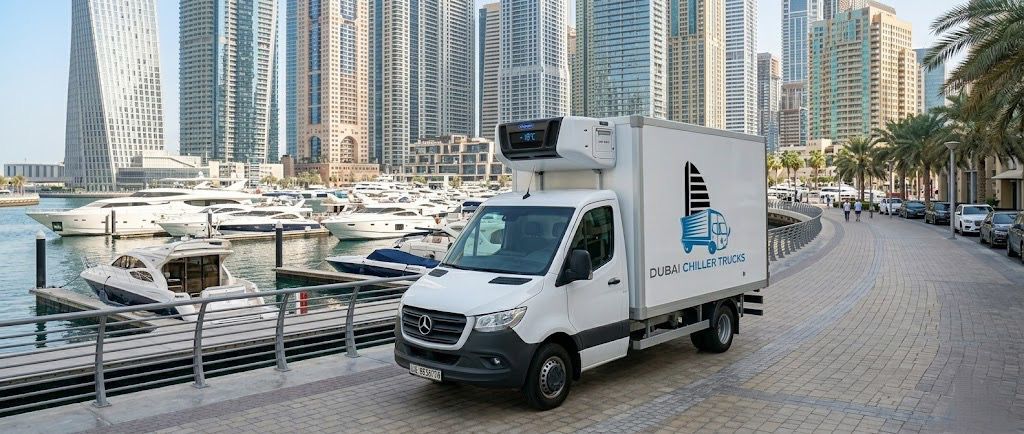
Active refrigeration — the approach used in a certified refrigerated van — works fundamentally differently. The refrigeration system does not simply slow the ingress of heat. It actively removes heat from the cargo compartment, expelling it to the external environment through the condenser and maintaining the internal temperature at the set point regardless of the external differential. A Thermo King or Carrier refrigeration unit operating on a Dubai Chiller Trucks refrigerated van maintains 5°C in 47°C ambient conditions — a 42°C differential — continuously throughout transit. The same unit maintains this temperature at each delivery stop, during traffic delays, during loading operations, and throughout the complete route — because the refrigeration system is running continuously, removing heat as fast as it enters through the insulated walls.
Good Distribution Practice requirements from the UAE Ministry of Health establish the documentation, vehicle qualification, driver training, and temperature monitoring standards for pharmaceutical refrigerated Truck transport in the UAE. These requirements apply to all temperature-sensitive pharmaceutical products — including vaccines, biologics, insulin products, and a growing range of specialty medications — during distribution from wholesaler to healthcare facility. Dubai Chiller Trucks pharmaceutical refrigerated van service operates under GDP-compliant protocols with the documentation standards that Ministry of Health compliance monitoring and pharmaceutical company audit requirements expect.
The Emirates Authority for Standardisation and Metrology’s cold transport standard applies across the GCC and establishes the mandatory use of active refrigeration for all regulated cold cargo transport. For chilled food categories, the standard specifies maximum transport temperatures that vary by product category within the 0°C to +8°C range. For frozen categories, -18°C is the maximum permissible temperature. Passive insulation is not recognised as compliant cold transport under this standard for any regulated food category in the Gulf climate. Dubai Chiller Trucks active-refrigeration fleet meets ESMA requirements on every delivery across every emirate we serve.
Dubai Municipality’s Food Safety Department applies specific compliance standards to all commercial vehicles transporting regulated food and pharmaceutical products within Dubai emirate. These standards require active refrigeration — not passive insulation — for vehicles transporting regulated chilled or frozen cargo categories. Compliance monitoring includes roadside vehicle inspections, receiving facility inspections, and documentation reviews. Non-compliant refrigerated Truks transport — evidenced by temperature excursions, inadequate vehicle certification, or absence of monitoring documentation — results in regulatory action that includes fines, product rejection, and in serious cases, operator licence suspension.
Dubai Chiller Trucks refrigerated vans carry the complete documentation portfolio that Dubai Municipality compliance monitoring requires — commercial vehicle licence, refrigeration unit calibration certificate, driver certification, and trip temperature logs available on demand at any inspection point.
Excellent service and clean vehicles! We use their 3-ton chiller trucks for daily deliveries — always on time.”
“We hired a 7-ton cooling truck for our catering business. Smooth process, fair prices, and reliable staff.”
“Best freezer hire service in Dubai. Their trucks are new, clean, and well-maintained.”
Pharmaceutical cold chain transport using refrigerated vans in the UAE carries a compliance burden that is distinct from food cold chain transport — and that places specific, documented requirements on every element of the operation from vehicle qualification through driver certification to delivery documentation.
The UAE Ministry of Health’s Good Distribution Practice guidelines for pharmaceutical temperature-sensitive products require that every refrigerated vehicle used for pharmaceutical transport carries a current vehicle qualification record — a documented assessment confirming that the vehicle’s refrigeration system, insulation performance, and temperature monitoring equipment are capable of maintaining the required temperature range under the operating conditions it will encounter. This is not a self-assessment. It is a documented validation process that a professional cold chain operator conducts and that pharmaceutical clients are entitled to request and review as part of their supplier qualification process.

Dubai Chiller Trucks refrigerated vans serving pharmaceutical clients carry current vehicle qualification documentation. Our temperature monitoring equipment carries current calibration certification traceable to national standards. Our drivers carry UAE commercial vehicle licences and cold chain handling training certificates specific to pharmaceutical cargo. And our trip temperature reports include all of the data elements — vehicle identification, sensor calibration reference, pre-cooling verification, continuous in-transit data, and delivery acceptance records — that pharmaceutical GDP auditors require in a complete cold chain transport record.
Dubai Chiller Trucks HACCP certification covers our refrigerated van operations across both chiller and freezer temperature configurations — with distinct critical control point documentation, pre-cooling protocols, monitoring requirements, and corrective action procedures for each configuration. When your cold chain is audited — by a Dubai Municipality inspector, a retail buyer’s food safety team, or a pharmaceutical company’s GDP audit — our documentation provides independently verified answers to every compliance question raised, regardless of which temperature configuration your refrigerated van operated under.
Every Dubai Chiller Trucks refrigerated van carries a certified Thermo King or Carrier active refrigeration unit with a current calibration certificate, a documented preventive maintenance history, and a service schedule calibrated for Gulf climate operating conditions. We do not operate passive insulation vehicles, uncertified active units, or equipment operating beyond its service intervals. Our maintenance records are available for review by clients who require supplier vehicle qualification documentation as part of their cold chain compliance processes.
Pre-cooling the refrigerated van’s cargo compartment to target temperature before loading begins is a mandatory step in our operating procedure — not an optional practice that drivers may exercise at their discretion. For chiller configurations, this means the compartment reaches 0°C to +8°C before loading authorisation. For freezer configurations, this means -18°C to -22°C is verified at multiple compartment measurement points before any frozen cargo is introduced. These pre-cooling confirmations are recorded as the opening entries in every trip temperature log — We provide Refrigerated Van rental services in Dubai. documented evidence that the cold chain began correctly at the loading stage, not just during transit.
Dubai Chiller Trucks operates refrigerated vans in both chiller and freezer configurations — allowing us to serve the complete spectrum of temperature-controlled cargo requirements with the correctly specified vehicle for each category. A business managing multiple cargo streams — chilled pharmaceutical deliveries in the morning, frozen food distribution in the afternoon — can consolidate their refrigerated van requirements with a single certified provider who operates the right vehicle for each application, rather than managing separate relationships with different providers for different temperature ranges.
Call +971 589137591 or WhatsApp our operations team. Provide your cargo type and description, the temperature specification your cargo requires — or ask our team to confirm the appropriate temperature configuration for your cargo category — your payload estimate, collection point, delivery destination or destinations, required date and time, and any specific compliance documentation requirements. For pharmaceutical cargo, include the applicable regulatory framework — Ministry of Health GDP, specific pharmaceutical company cold chain audit standard — so we can prepare the correct documentation package before departure.
Our team confirms the correct temperature configuration — chiller or freezer — for your cargo and provides a complete all-inclusive rate covering driver, pre-cooling to verified target temperature, GPS tracking, continuous temperature monitoring, fuel for the agreed route, commercial insurance, and VAT. The rate confirmed at this stage is the rate on your invoice. No additions will appear after delivery.
On booking confirmation, your refrigerated van and licensed driver are assigned immediately. Pre-cooling of the cargo compartment to the confirmed target temperature begins at the scheduled lead time before your collection window. You receive the driver’s direct contact number, vehicle registration details, and confirmed arrival time at your collection point. For pharmaceutical bookings, documentation preparation — chain-of-custody records, vehicle qualification reference, driver certification details — begins at this stage.
Your driver arrives with the cargo compartment at verified target temperature — confirmed at multiple measurement points for freezer-configuration bookings. The pre-cooling verification readings are recorded as the opening entry in the trip temperature log. Loading is authorised only when target temperature is confirmed throughout the compartment. This verification step is non-negotiable in our operating procedure and is documented on every trip.
A refrigerated van is fitted with an active mechanical refrigeration unit — a certified Thermo King or Carrier system — that continuously removes heat from the cargo compartment and maintains a precise set temperature throughout every delivery, regardless of external ambient conditions. An insulated van uses only passive thermal protection — slowing heat gain but never actively removing it. In Dubai’s summer ambient temperatures above 47°C, an insulated van without active refrigeration reaches unsafe product temperatures within 15 to 20 minutes of loading. A certified refrigerated van eliminates this risk entirely because the refrigeration system actively opposes the heat differential rather than merely slowing its effect. Dubai Chiller Trucks operates only active-refrigeration certified vehicles — no passive insulation alternatives are offered for any regulated cold cargo category.
Dubai Chiller Trucks refrigerated vans are available in chiller configuration maintaining 0°C to +8°C — for fresh produce, dairy, pharmaceuticals, chilled beverages, and all fresh perishable cargo — and in freezer configuration maintaining -18°C to -22°C for frozen food, frozen seafood, ice cream, frozen ready meals, and deep-freeze cargo categories. Within the chiller range, specific sub-targets can be set for cargo with narrower temperature requirements — pharmaceutical products typically requiring +2°C to +8°C, for example. The correct configuration for your specific cargo is confirmed by our operations team at the time of booking based on your cargo’s temperature specification.
Yes. Dubai Chiller Trucks holds independently audited HACCP certification covering our complete refrigerated van fleet across both temperature configurations. Our operations fully meet Dubai Municipality Food Safety Department commercial refrigerated transport standards, ESMA standard UAE.S GSO 2055-1, and UAE Ministry of Health GDP requirements for pharmaceutical transport. Temperature logs are stored for 90 days minimum and provided in a format suitable for regulatory submission — Dubai Municipality audit, HACCP records, pharmaceutical GDP files, or retail buyer cold chain review — without additional processing.
Yes. Same-day refrigerated van rental is available across Dubai and the UAE, subject to fleet availability. Call or WhatsApp +971 589137591 at least 2 to 3 hours before your required departure time for chiller-configuration bookings, and at least 3 to 4 hours for freezer-configuration bookings to allow adequate pre-cooling lead time. Our operations team confirms vehicle and driver assignment within the hour for accepted same-day requests.
Any cargo with a regulatory, manufacturer, or customer temperature specification requires a certified refrigerated van for transport in Dubai — because a standard cargo van reaches internal temperatures of 60°C to 70°C in direct Dubai summer sunlight within minutes of stationary parking, and exceeds safe temperature thresholds for virtually all perishable cargo within 5 to 10 minutes of loading. This applies to fresh produce, dairy, chilled beverages, pharmaceuticals, vaccines, fresh meat, fresh seafood, fresh flowers, temperature-sensitive cosmetics, and any frozen cargo. If your cargo has a temperature specification, use a certified refrigerated van. Contact our team to confirm the right vehicle and configuration for your specific cargo category
Copyright © Dubai Chiller Trucks | Developed and SEO by MindGigs
